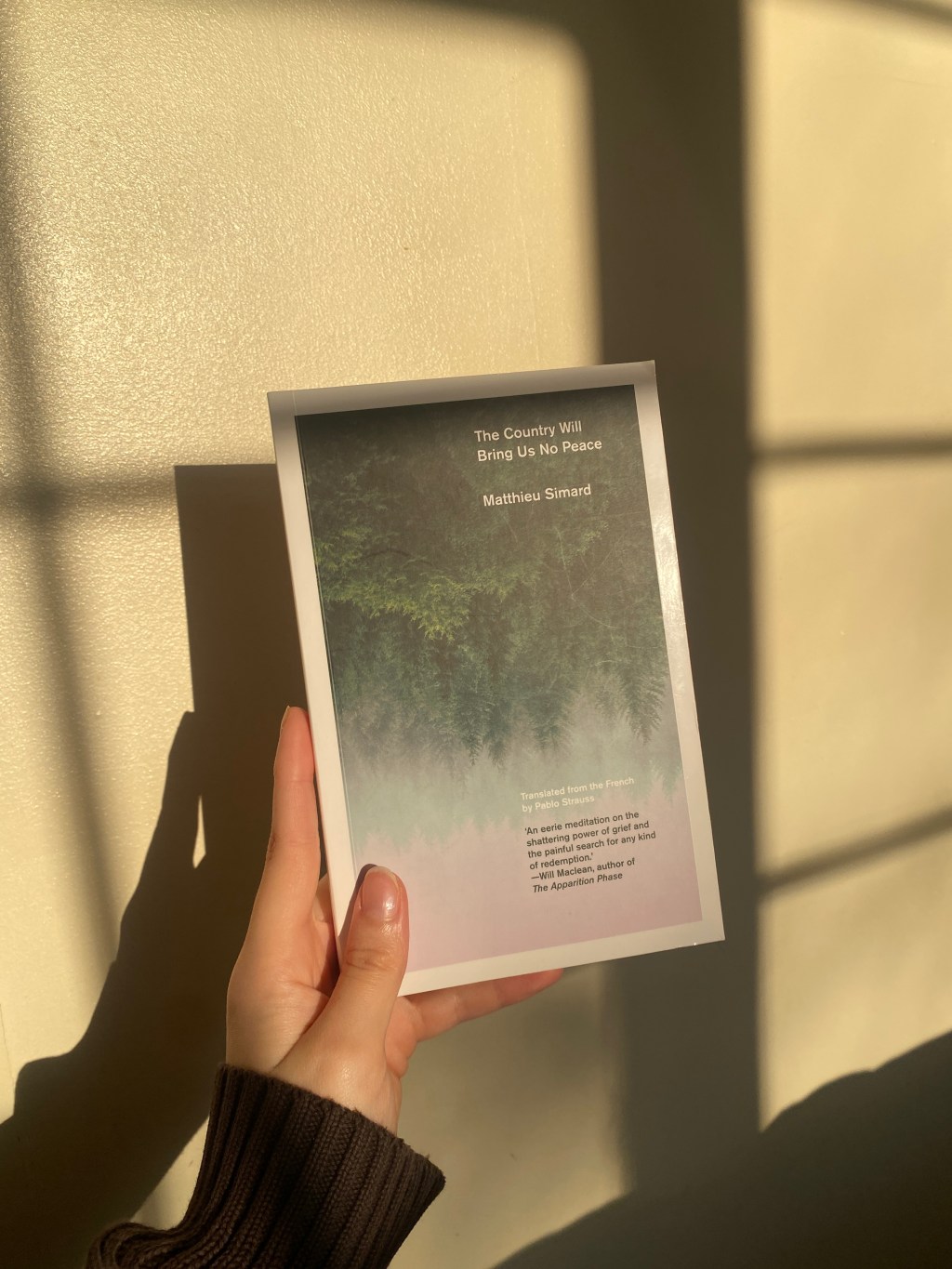
Book Synopsis:
Simon and Marie can’t seem to have a baby. They decide to flee the city for an idyllic village, where things, they tell themselves, must be better. But their new home is gloomy, threatening, tinged with tragedy – things have not been the same since the factory closed down and the broadcast antenna was erected.
This book felt so quietly unnerving. A young couple move to a town that collects grief and slowly, after they collect the stories of the locals, something horrible unfolds.
Despite some people calling this book a ‘horror’, I would not label it as such. It’s more of a literary thriller. The prose is very precise (a good translation from the French I think) in its depictions of both the town and its inhabitants and I think it does well as showing the permanent lingering of grief so many of us know.
The chapters switch between the point of view of our two main characters, neither of them ‘likeable’ in the typical way. Both are trying to escape themselves, and their past and spend a lot of the novel hiding secrets from each other.
The town locals are an uninviting bunch and are suspicious of Marie and Simon. Amongst them are a local ‘handy-man/garage owner’ who forces a kiss on Marie when they meet, the store owner who hates his life there, a cafe waitress who is always smiling but makes it clear the couple aren’t welcome, an annoying family staying in their holiday home, and an mysterious deaf-mute girl named Alice. A lot of the content of this novel are the different interactions that Marie and Simon have with these people.
Every town has its stories. Dark secrets, accidents, disappearances…Every little town has the same stories, and they’re always a lot like our own.
I’m extremely grateful that Simard chose to write this as a novella. At 126 pages, the use of page breaks instead of chapters and slow, bleak narrative are endearing instead of making the book drag. I’ve read similar books dragged out over four-hundred pages which don’t convey as much atmosphere as this did in one hundred. I was able to read this book in one evening and feel it was the right length for the events in it.
There is a scene I don’t want to overlook in this book that was very jarring and, in my opinion, unnecessary on page 74. Whilst Simon is touching a cello case, Marie suddenly forces him into the bedroom and forces herself on him. Simon is repeatedly described as ‘pulling away’ and then ‘relenting’. It is a large paragraph that ends with Marie apologising to a silent Simon and then leaving the house to go on a run.
Whilst of course there is a place, in fiction, for the discussion of this serious topic, it doesn’t seem to flow naturally from what precedes it and feels disconnected from the overall narrative. One could potentially interpret this scene as an attempt to explore themes of power, vulnerability, or perhaps a breakdown in the characters’ relationship. However, the depiction of non-consensual acts is still deeply concerning and due to the lack of explanation and linking back afterwards, I don’t feel it added to the narrative at all. I also fear this really did lower my overall enjoyment of the book. I found the way this small element was written was problematic and ruined the parts of Marie and Simon’s relationship that were building up a complex relationship.
In terms of an ending (although omitting any spoilers), I will say that this is the one part of the book where I found the pacing to be off. The ending felt rushed and quite unsatisfying. I would say the end was the part of this novella that leaned most into the ‘supernatural/horror’ aspects of the book but I wish the foreboding had been integrated better in the middle section of the storyline.
Back in January, I played a video game called Trüberbrook with my brother, a thrilling mystery adventure game set in rural Germany in the late 1960s. The player takes the role of young American physicist Tannhauser, who happens to end up in the eponymous village of Trüberbrook, an ageing but beautiful health resort somewhere in the densely forested countryside of West Germany. Full of sci-fi/mystery elements and an uninviting cast of locals, it gave me the exact same unnerving feeling as this novel. I highly recommend it if you like a story-based game with puzzle elements.

I also found it similar in style and theme to the book ‘Our Wives Under the Sea’ by Julia Armfield, although I have to say that I much preferred that novel leaning more into the horror elements that this novel shied away from.
Overall, I would recommend giving this book a go, the length alone is a compelling reason. The author does a good job at focusing on the permanence of grief and the trace death leaves on our lives. However, I would say to be mindful of the ‘weirder’ elements of the novel and to consider the intent and context surrounding them.
Is there a book that you think creates an unsettling atmosphere well?
 ExlibrisJessica
Leave a comment